

Here’s What The Potential Data Center Developer Is Telling Us
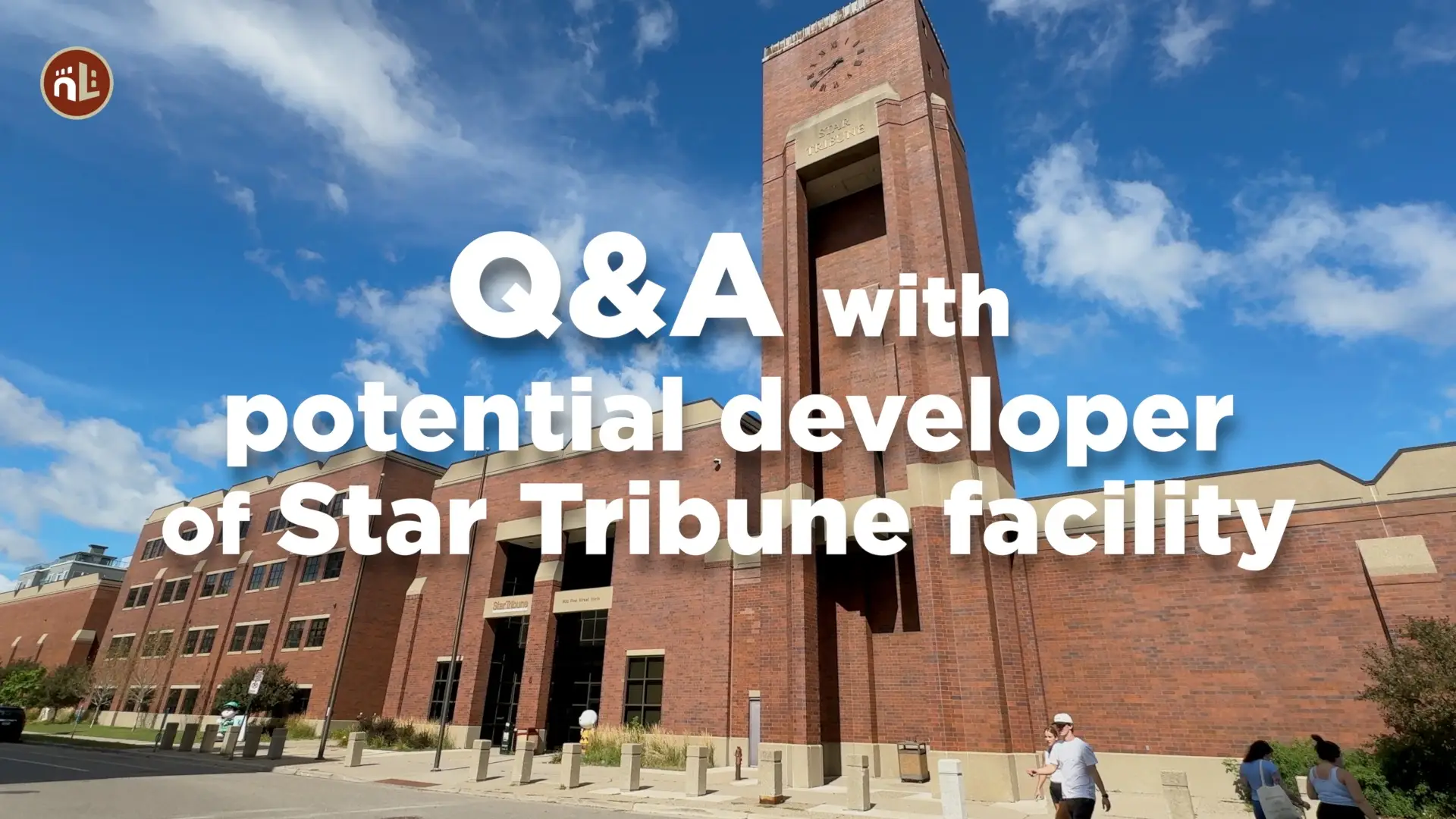
This week, the North Loop Neighborhood Association (NLNA), in partnership with the U of M’s Minnesota Design Center, is hosting community workshops to gather community input about the proposed data center + multi-use development at the former Star Tribune printing facility.
In advance of those workshops, the NLNA asked the potential buyer, Legacy Investing, for an interview about their plans and experience with data centers. The NLNA has not yet taken a position on the proposed development, but wanted to hear from the developer firsthand.
Legacy Investing will present their plans for converting the printing facility to a data center at the NLNA Planning + Zoning committee meeting on August 19; the meeting starts at 6pm. Presenting for Legacy (via Zoom) will be Managing Partner Daniel English and Vice President of Development Ari Chernikoff.
The sale to Legacy Investing is not complete; the firm has just begun the approval process with the City of Minneapolis, but here’s what Managing Partner Daniel English can say at the present time in response to the most common questions about data centers.
—————————-
Why here?
Printing presses convert well into data centers. A printing press building is extremely hard to convert into much. They tend to have very tall ceilings, structurally sound slabs that handle weight and they tend to have a certain amount of infrastructure because of the equipment that was in those buildings. And not a lot of windows, either.
And so we have printing press data centers in Cleveland and Cincinnati, and they convert very successfully because you don’t need to change the building, the exterior, it’s just all happening within the inside of the building.
Who’s the data center for?
We don’t know. Data centers are built similarly to how you would build an apartment building; you don’t know who’s going to live there when it’s built. Data centers now work in the same way. Everything that requires compute that lives in a data center is pretty broad. We have buildings where the folks who have looked to go into it are video game companies to cloud-based services to AI. So whether it’s your Starbucks coffee purchase that’s being processed in a data center, your airline ticket is being processed in a data center, your TikTok video, your ChatGPT request; they’re all using compute, and they’re all using servers to do that.
How large will the data center be?
Large data centers are today millions of square feet, and north of 300 megawatts.
[For this site] we’re around 20 megawatts initially, so that’s smaller than the Sleep Number building’s data center [in downtown Minneapolis]. In the scheme of data centers, you don’t see data centers smaller than this anymore.
How do you address concerns about water use for cooling?
If you use water-based evaporative cooling, there’s a lot more water that’s being used. That’s true of any building that cools in that way. Data centers now, they’re using closed-loop systems and air-cool technology, so we’re using very, very little water, far less water than say, a golf course. It’s really the equivalent of a few homes.
What about noise?
The good news is, when using a printing press building, you can put the generators inside the building. So one, you don’t see them. Two, there’s far less sound and we also use things like mufflers and dampers on them to minimize the sound. Noise can be managed in data centers.
What about additional pressure to our power grid?
That’s another advantage to converting a printing press to a data center. We can rely on existing power infrastructure that adds no new strain to the grid.
Why can’t the building be converted to some other use?
Converting the printing press building to something other than a data center is really financially unviable, so turning that building into say, an apartment tower, is not financially feasible. We want to preserve it, not change it.
The Star Tribune building is effectively three giant warehouses. It is very difficult to convert that structure due to a combination of the economics of what it would take, even just tearing it down the building, which nobody wants, but that would be astronomically expensive.
This property is zoned for “production mixed use.” If the former printing press is converted to a data center, what are your plans for the rest of the land?
We’re not the current owners, but we’re under contract to acquire the property and three additional parcels surrounding it. The building converts fairly naturally to a data center.
What’s exciting about the Star Tribune building is that there are parcels around it that are open that we can program for, so that is something that we want to take advantage of and discuss with the community. There’s a shared interest if these are things we’re going to use and live with and have broader benefits for the city, can we leverage the fact that a data center is in the area to open up the area for other uses as well.
We would love input from the community, and now is definitely the time to receive that input. We don’t own it yet; there’s still time to be thoughtful.
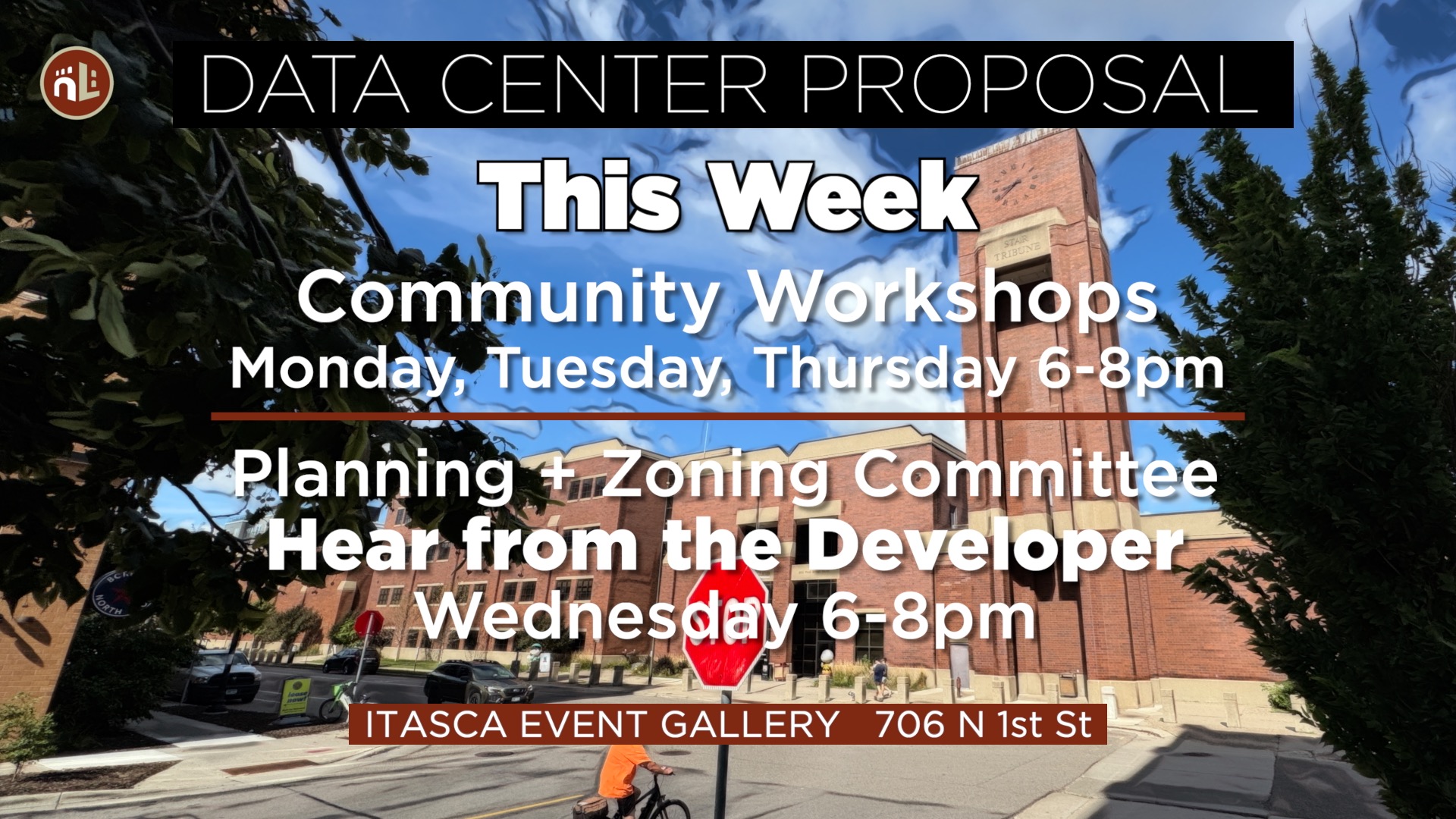
The community workshops take place August 17, 18 and 20 from 6 to 8pm at Itasca Event Gallery, located in the back of Itasca Wine & Spirits at 706 N. 1st St. The workshops will be facilitated by faculty, graduate students and support staff from the U’s Minnesota Design Center (MDC), in an effort to thoughtfully share ideas on how to develop this large area.
MDC facilitators will summarize the week’s work into a Report to the Community, and present it to the neighborhood on Saturday, August 22 from 1 to 2:30pm at Fulton Taproom, 414 6th Ave. N. The report will also be shared with the developer and City leaders.
— By Mary Binkley, NLNA President